India Car Market 2026 — Sales Records, Big Trends and What It Means for You as a Buyer
India Car Market 2026 — Sales Records, Big Trends and What It Means for You as a Buyer
India’s car market in 2026 is firing on all cylinders. Record sales, fierce brand battles, an electric vehicle revolution quietly taking root, and a rural India that is buying cars faster than urban India — the story of the Indian automobile market in 2026 is one of unstoppable momentum and fascinating transformation.
Whether you are planning to buy a car this year or simply want to understand why certain cars are selling like crazy while others are struggling — this deep dive into the real numbers and real trends will give you the complete picture.
The Big Number — India Sold 4.7 Million Cars in FY2026
Let that sink in. Car sales surged 13 percent to 4.7 million units in FY2026 from 4.16 million units the previous year. India is now firmly among the top three automotive markets in the world, ahead of Japan and closing in on the United States. CarHP India
India’s passenger vehicle industry closed FY2026 on a strong note, clocking total sales of 46.83 lakh units and reflecting a healthy 8.4 percent year-on-year growth. This growth is not a one-year anomaly — it is part of a decade-long structural expansion of the Indian middle class and their aspiration for personal mobility. CarDekho
The momentum has continued into FY2027. In April 2026, carmakers sold 4,07,335 units, recording the highest-ever April sales and a 12.21 percent year-on-year growth. CarTrade
Brand Wars — Who Won FY2026
The most dramatic story of FY2026 was not about which cars sold — it was about which brands rose and fell in the rankings.
Maruti Suzuki remains India’s undisputed king but is showing cracks. Maruti Suzuki sold 18.2 lakh units but for the first time its market share dipped below the 40 percent psychological barrier, ending the year at 38.9 percent down from 40.8 percent in FY2025. Maruti is still dominant but rivals are eating into its territory. ZigWheels
Mahindra’s historic rise is the biggest story. Mahindra’s surge with robust 19.7 percent growth saw it sell 6,60,276 units and capture a 14.1 percent market share, driven by its SUV-only strategy with models like the Scorpio-N, XUV700, and newly launched XUV 7XO. Mahindra overtook both Tata and Hyundai to claim second place — a seismic shift in India’s brand rankings. ZigWheels
Tata Motors delivered strong growth. Despite a healthy 14.1 percent growth and record sales of 6,31,387 units, Tata slipped to third place. Tata’s EV leadership and the success of the Nexon and Punch continue to power its momentum. ZigWheels
Hyundai had a rare bad year. Hyundai Motor India saw a 2.3 percent decline with market share dropping from 13.9 percent to 12.6 percent. The lack of new launches in key segments hurt the Korean brand significantly. ZigWheels
Skoda’s extraordinary comeback deserves special mention. Skoda recorded a staggering 68.4 percent growth — the highest in the industry — with the success of the Kylaq and updated Kushaq breathing new life into the brand and increasing its market share to 1.6 percent. The Kylaq in particular proved that Indian buyers are willing to pay for European build quality and safety. ZigWheels
Renault’s remarkable revival was powered by the new Duster. Renault recorded one of the highest year-on-year sales surges of any carmaker — 42.4 percent — thanks to the highly anticipated launch of the new Duster in March 2026. CarTrade
The SUV Takeover Is Complete
If there was any doubt remaining about India’s shift to SUVs — FY2026 ended it. The Indian PV market shows a clear shift in consumer preference toward premium SUVs across all tiers. ZigWheels
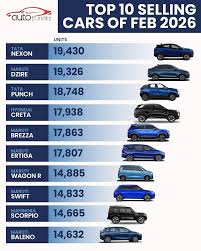
SUVs and utility vehicles now account for over 60 percent of all passenger vehicles sold in India. The traditional hatchback — once the backbone of the Indian car market — is being squeezed from below by micro-SUVs like the Tata Punch and from above by compact SUVs like the Nexon and Creta.
The reasons are clear to any Indian buyer: SUVs offer higher ground clearance for rough roads, a commanding driving position, more perceived safety, and — most importantly in a brand-conscious market — stronger social status.
Rural India Is the New Growth Engine
One of the most significant and underreported trends of 2026 is rural India’s surging car buying appetite.
Rural markets’ share in passenger vehicle sales rose to 41.2 percent in April 2026, up from 38.3 percent in FY2025. Rural sales surged 20.4 percent in April 2026, almost triple the 7.11 percent pace for urban centres. CarTrade
This matters enormously for the Indian automotive industry. Rural buyers tend to prioritise different things — reliability, low maintenance costs, high ground clearance, strong service networks in smaller towns, and value for money over premium features. The brands that understand this — Maruti, Tata, Mahindra — are benefitting massively.
For buyers in smaller Indian cities and towns, this rural boom means more dealerships, more competition, and better deals from manufacturers who are now actively targeting your market.
The EV Revolution — Growing Fast but Still Small
Electric vehicles had an explosive FY2026 in India. EV sales increased 84 percent to 1,99,923 units in FY2026 from 1,08,873 units — a growth of over 91,000 units. CarHP India
But here is the honest context — despite surging about 320.6 percent over a longer period, EVs still constitute only 4.3 percent of the total car market. The electric revolution in India is real but it is still early stage. The vast majority of Indian buyers are still buying petrol cars. CarDekho
Electric vehicles contributed to almost one-fifth of the incremental growth in passenger vehicle sales in FY2026, helping domestic carmakers Mahindra and Tata Motors oust Hyundai Motor India from the No. 2 position. CarHP India
The key takeaway: EVs are growing fast and will become increasingly important. But for most Indian buyers in 2026, a well-chosen petrol or CNG car remains the practical and financially smart choice unless your usage pattern specifically suits an EV.
GST 2.0 — The Policy Change That Fuelled Growth
A major driver of India’s car sales boom in FY2026 was GST reform. Retail sales growth was supported by GST 2.0 reforms, the Reserve Bank of India’s supportive rate stance which translated into stronger EMI affordability, and strong marriage-season demand. CarTrade
Lower GST on smaller cars made them significantly more affordable for first-time buyers. Combined with multiple RBI repo rate cuts that brought EMI costs down, the total cost of buying a car in India in FY2026 was meaningfully lower than previous years for budget-segment buyers.
This is a direct benefit if you are planning a car purchase — your EMI on the same car is lower today than it would have been two years ago.
Segment by Segment — Where the Action Is
Compact SUVs (₹8-15 lakh): The most competitive segment in India. The Nexon, Creta, Brezza, Venue, Sonet, Kushaq, Kylaq, and Fronx are all fighting for the same buyer. Deals and discounts are aggressive — use this competition to your advantage.
Mid-Size SUVs (₹15-25 lakh): Growing rapidly. The XUV700, Thar Roxx, Creta, Seltos top variants, and Taigun are all competing here. Mahindra is dominating this space in 2026.
Premium SUVs (₹25-50 lakh): The fastest growing segment by percentage. Indian buyers are aspirational and increasingly willing to stretch budgets for Kodiaq, Tayron, Fortuner, and Meridian variants.
Sedans: Declining in volume but far from dead. The Dzire’s record sales prove that the right sedan at the right price still sells brilliantly in India. The Virtus and Slavia continue to find enthusiastic buyers who value driving dynamics over SUV practicality.
Electric Vehicles: Growing fastest but from a small base. The Nexon EV, Creta Electric, Windsor EV, and BE 6 are leading the segment. Expect this to accelerate significantly through 2026 and 2027.
What This Means for You as a Car Buyer in 2026
Buyer’s market in several segments: The intense competition between brands means better deals, more features per rupee, and aggressive exchange offers. Never accept the first price from a dealer.
EMI affordability is at a multi-year high: The RBI rate cuts have made car loans cheaper. Shop around between banks and NBFCs for the best interest rate before finalising your loan.
Rural dealers are improving: If you are buying in a smaller city, the quality of dealership experience and after-sales service has improved dramatically as brands compete for rural market share.
EV charging is expanding but verify locally: Before buying an EV, specifically check the charging infrastructure in your city and on your most-travelled routes. Do not rely on national statistics — ground reality varies significantly by location.
Resale values are shifting: SUVs continue to hold value better than sedans. EVs are showing improving resale trends as the used EV market develops. Factor this into your total ownership cost calculation.
Final Verdict — India’s Car Market in 2026
India’s automotive story in 2026 is one of extraordinary growth, intensifying competition, and genuine transformation. Mahindra’s historic rise, Skoda’s dramatic comeback, the EV revolution beginning to gather real pace, and rural India emerging as the next big growth frontier — these are not temporary trends. They are structural shifts that will define the Indian car market for the next decade.
For the Indian car buyer, 2026 offers the best combination of choice, affordability, and technology ever available. The right time to buy is when you are ready — and the market in 2026 will reward a well-researched buyer handsomely.
Also read: Best Selling Cars in India April 2026 and Best Cars Under ₹20 Lakh in India 2026.
External source: Autocar India — April 2026 Car Sales