JSW Jetour T2 PHEV 2026 India — The Most Interesting New PHEV SUV Nobody Is Talking About
India’s plug-in hybrid segment just got significantly more interesting. The JSW Jetour T2 PHEV is arriving in India as part of the JSW-Jetour partnership — one of the most strategically significant automotive joint ventures announced in India in recent years. JSW Group — one of India’s largest conglomerates with steel, energy, and infrastructure at its core — partnering with Jetour, the fastest-growing Chinese SUV brand globally, to build and sell vehicles in India. The T2 PHEV is their most ambitious product — a plug-in hybrid compact SUV that targets the BYD Sealion 6 DM-i directly while offering local manufacturing credentials that pure imports cannot match. Here is everything you need to know.
The JSW-Jetour Partnership — Why It Matters
Before getting into the car itself — the partnership deserves explanation because it significantly affects the T2 PHEV’s value proposition.
JSW Group’s involvement means the T2 PHEV will have local manufacturing — likely at JSW’s existing facilities — which removes the import duty burden that makes fully imported Chinese vehicles expensive in India. This is the same strategic advantage that has allowed Maruti-Suzuki and Hyundai-Kia to dominate Indian car sales for decades — local manufacturing unlocks price points that imports simply cannot match.
Jetour globally has grown from zero to one of China’s top-selling SUV brands in under five years — a growth trajectory that reflects genuine product quality rather than just pricing. The T2 specifically has been one of Jetour’s strongest global performers — praised for its design, interior quality, and PHEV system efficiency in markets across the Middle East, Southeast Asia, and Eastern Europe.
Design — Premium and Contemporary
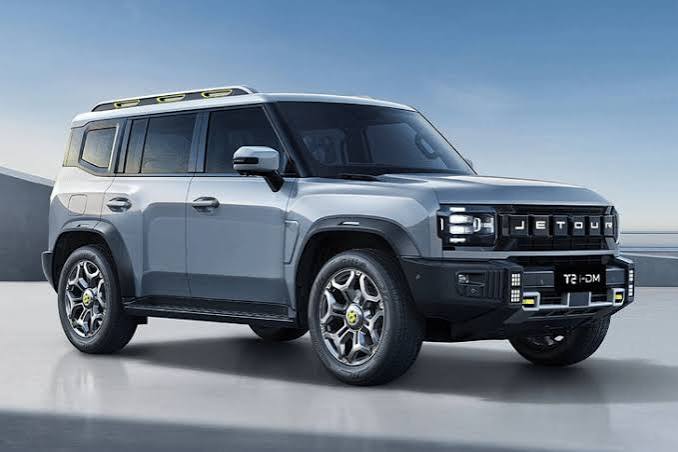
The JSW Jetour T2’s design is immediately striking — more premium and more sophisticated looking than its price positioning suggests.
Exterior highlights:
- Bold front fascia with distinctive split LED headlamp arrangement
- Full-width LED light bar connecting both headlamps
- Clean body surfaces with minimal unnecessary creasing
- Strong shoulder line running the full body length
- 18-inch alloy wheels on standard variants — 19-inch on top
- Integrated rear spoiler
- Full-width LED tail lamp strip
- Dual-tone colour options available
- PHEV-specific blue accent detailing
The overall design language is contemporary and European-influenced — deliberately avoiding the aggressive styling that some Chinese brands use to stand out, in favour of a cleaner, more restrained aesthetic that communicates premium quality.
Key dimensions:
| Specification | Details |
|---|---|
| Length | 4,520 mm |
| Width | 1,862 mm |
| Height | 1,680 mm |
| Wheelbase | 2,710 mm |
| Ground Clearance | 195 mm |
| Boot Space | 420 litres |
Interior — Where the T2 PHEV Makes Its Strongest Argument
The JSW Jetour T2’s interior is genuinely impressive — delivering a premium quality cabin that comfortably matches rivals costing significantly more.
Key interior features:
- 15.6-inch rotating touchscreen — the T2’s most dramatic feature
- 12.3-inch digital instrument cluster
- Wireless Apple CarPlay and Android Auto
- Connected car technology suite
- Panoramic sunroof
- Ventilated and heated front seats
- Wireless charging
- 8-speaker audio system
- Ambient lighting — multiple colour options
- Head-up display on top variants
- Level 2 ADAS suite
The 15.6-inch rotating touchscreen is the cabin’s centrepiece — it rotates between landscape orientation for maps and portrait orientation for media, creating a genuinely flexible and visually impressive infotainment experience. This feature was previously seen on the BYD Atto 3 and the rotating mechanism has proven reliable across thousands of international examples.
PHEV Powertrain — Efficient and Well-Engineered
| Specification | Details |
|---|---|
| Petrol Engine | 1.5L Turbo Petrol |
| Electric Motor | Front-mounted |
| Combined Power | 245 HP |
| Combined Torque | 430 Nm |
| Battery | 18.3 kWh |
| Pure EV Range | 105 km |
| Combined Range | 1,050 km |
| 0-100 kmph | ~6.8 seconds |
| Fuel Consumption | ~1.2L/100km official |
The T2 PHEV’s 18.3 kWh battery delivering 105 km of pure electric range means most Indian urban buyers can complete their entire week of city commuting on electricity alone — charging overnight at home — while retaining the 1,050 km combined range for complete highway freedom without any range anxiety.
245 HP combined output and 6.8 seconds 0-100 kmph makes the T2 PHEV genuinely quick — quicker than any non-PHEV rival at this price. The 430 Nm of combined torque available from near-zero RPM creates the characteristic electric SUV launch feel that makes every traffic light feel effortless.
Charging
| Charging Type | Details |
|---|---|
| AC Home Charging | 6.6 kW |
| DC Fast Charging | 50 kW |
| Time Full Charge AC | ~3.2 hours |
| Time 10-80% DC | ~25 minutes |
The 18.3 kWh battery’s relatively compact size means AC charging completes in just 3.2 hours — a full overnight charge is easily accomplished even if you return home late. The 50 kW DC fast charging delivers a practical top-up in under 30 minutes during a highway rest stop.
Safety
| Feature | Details |
|---|---|
| Airbags | 8 standard |
| ADAS | Level 2 — full suite |
| ESC | Standard |
| AEB | Standard |
| 360 Camera | Standard |
| NCAP | Not yet tested in India |
Eight airbags standard across all variants and a comprehensive Level 2 ADAS suite — including adaptive cruise control, lane centring, and autonomous emergency braking — give the T2 PHEV one of the strongest safety equipment lists in its segment.
Expected Price
| Variant | Expected Price |
|---|---|
| T2 PHEV Standard | ₹28.00 lakh – ₹30.00 lakh |
| T2 PHEV Premium | ₹32.00 lakh – ₹34.00 lakh |
| T2 PHEV Elite | ₹35.00 lakh – ₹38.00 lakh |
Local manufacturing through JSW’s facilities is the key to these price points — a fully imported PHEV SUV with these specifications would cost significantly more. At ₹28 to ₹38 lakh the T2 PHEV positions itself directly against the BYD Sealion 6 DM-i’s ₹45 to ₹58 lakh pricing — offering comparable PHEV technology and similar electric range at a significantly lower price.
JSW Jetour T2 PHEV vs Key Rivals
| Parameter | JSW Jetour T2 PHEV | BYD Sealion 6 DM-i | Hyundai Tucson | Kia Sorento Hybrid |
|---|---|---|---|---|
| Price | ₹28–38L | ₹45–58L | ₹29–36L | ₹35–42L |
| PHEV | Yes — 105km EV | Yes — 140km EV | No | No |
| Power | 245 HP | 218-344 HP | 186 HP | 238 HP |
| Screen | 15.6 inch rotating | 15.6 inch rotating | 12.3 inch | 12.3 inch |
| Local Manufacturing | Yes — JSW | No — import | Yes — local | Yes — local |
| NCAP | Not tested | Not tested | 5-star BNCAP | Not tested |
The T2 PHEV’s most compelling advantage is straightforward — PHEV technology with 105 km electric range at ₹28 lakh, when the only other PHEV SUV available in India starts at ₹45 lakh. That ₹17 lakh price gap is genuinely significant and directly reflects the local manufacturing advantage JSW brings to the partnership.
Challenges and Concerns
Brand credibility — JSW Jetour is a new name in India. Building buyer confidence in an unfamiliar brand takes time regardless of product quality. The first buyers of any new brand’s products take a genuine ownership risk that early adopters of established brands do not face.
Service network — at launch JSW Jetour’s service infrastructure will be limited. This is the most significant practical concern for buyers outside major cities.
Resale value — unknown. New brands in India consistently struggle with resale value in their early years regardless of product quality.
Long-term reliability — Jetour’s global track record is growing but lacks the depth of established Japanese and Korean brands with decades of Indian ownership data.
Motor Mogul’s Take
The JSW Jetour T2 PHEV is the most interesting new car announcement in India in 2026 — not because it is guaranteed to be excellent, but because it attempts something genuinely ambitious. Bringing a properly engineered PHEV SUV with 105 km of electric range and 245 HP to a ₹28 lakh price point through local manufacturing is a significant achievement if the product delivers on its specifications in real-world Indian ownership.
The BYD comparison is inevitable — and the T2 PHEV’s ₹17 lakh price advantage over the Sealion 6 DM-i is its most powerful argument. For buyers who want PHEV technology but find the Sealion 6’s pricing beyond reach — the T2 PHEV offers a genuinely accessible alternative.
The honest caveat is the same one that applies to every new brand entering India — wait and see. Buy in the first year and you are taking a risk on an unproven service network and uncertain long-term reliability. Wait 18 months for ownership data and reviews to accumulate — and if it proves reliable, the T2 PHEV will be one of the most compelling value propositions in India’s entire SUV market.
Final Verdict
The JSW Jetour T2 PHEV is a genuinely ambitious and genuinely interesting arrival — 245 HP combined, 105 km pure electric range, 1,050 km combined range, 15.6-inch rotating touchscreen, 8 airbags, Level 2 ADAS, and panoramic sunroof at ₹28 to ₹38 lakh through local manufacturing. The value proposition versus the BYD Sealion 6 DM-i is compelling. The brand credibility and service network concerns are real. For early adopters willing to take that risk — the T2 PHEV is one of the most technically impressive SUVs arriving in India in 2026 at its price point.
External source:
CarWale — JSW Jetour T2 PHEV India → https://www.carwale.com/jsw-jetour-cars/t2/