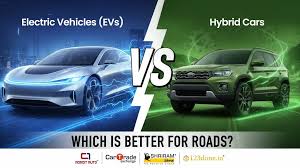
Electric vs Hybrid Car in India 2026 — The Honest Answer Every Buyer Needs Before Deciding
India’s car market in 2026 has a new decision that did not exist three years ago. It used to be petrol or diesel. Now it is petrol, diesel, CNG, mild hybrid, strong hybrid, or fully electric. The number of options is overwhelming — and the marketing from every manufacturer makes every technology sound like the obvious choice.
Hybrids promise fuel flexibility and peace of mind. EVs promise low running costs and cleaner driving. On paper, both look attractive. In reality, your driving pattern — not ideology — should decide. CarDekho
This guide cuts through the marketing and gives you the honest, practical answer based on real Indian driving conditions, real Indian infrastructure, and real Indian family usage patterns.
Understanding the Types — What You Are Actually Choosing Between
Before comparing, understand what each technology actually is. Many buyers are confused by the terminology — and some manufacturers use misleading language to make conventional cars sound more advanced than they are.
Mild Hybrid: Mild hybrids are essentially refinement upgrades, not fuel-saving game changers. If you are buying one, consider it a petrol car with better manners. Spinny
A mild hybrid adds a small electric motor that assists the petrol engine briefly during acceleration and recovers energy during braking. The engine never turns off. You cannot drive on electric power alone. Fuel savings are modest — typically 8 to 12 percent improvement over the equivalent conventional petrol engine. The Maruti Baleno, Swift, Fronx, and Brezza all use mild hybrid systems.
Strong Hybrid: A strong hybrid has a significantly larger battery and electric motor. The petrol engine can completely shut off — particularly in city stop-and-go traffic — with the car running entirely on electric power. The battery charges itself from the engine and regenerative braking. You never plug it in. The Maruti Grand Vitara, Toyota Hyryder, Honda City e:HEV, and Toyota Innova HyCross all use strong hybrid systems.
Real-world fuel efficiency from strong hybrids in Indian city conditions: 20 to 25 kmpl — genuinely transformative compared to conventional petrol alternatives.
Full Electric (EV): No petrol engine. Entirely electric. Must be charged from an external power source — home charger, public charger, or DC fast charger. Running costs of approximately ₹1 to ₹1.50 per km in Indian electricity prices — the lowest of any powertrain available. Zero tailpipe emissions. No engine oil, no gearbox oil, significantly fewer moving parts than any petrol or hybrid vehicle.
The Four Questions That Determine Your Answer
India’s uneven charging infrastructure, traffic-heavy cities, and mixed highway conditions mean the best option depends heavily on how and where you drive. CarDekho
Question 1: Do you have home charging access?
This single question changes the EV ownership experience completely.
With home charging — you plug in every night, wake up to a full battery, and never think about range anxiety. Charging becomes as automatic as charging your phone. The running cost of ₹1 to ₹1.50 per km starts compounding savings immediately.
Without home charging — you depend entirely on public charging infrastructure which remains inconsistent in India outside major cities. EV ownership without home charging is genuinely stressful. In this case — a strong hybrid is the better choice.
Question 2: What is your primary driving pattern?
Hybrid cars perform best in stop-and-go traffic. Electric motor support reduces fuel consumption dramatically in city driving. CarDekho
Strong hybrid efficiency advantage is highest in city traffic where frequent stops allow the engine to shut off and electric motor to take over. On highways at sustained speeds — the strong hybrid’s advantage reduces because the petrol engine must run continuously.
EVs are most efficient in city driving AND increasingly competitive on highways as range improves.
Question 3: Do you make frequent long highway trips?
Hybrids eliminate range anxiety completely. You never think about charging. EVs require awareness of remaining range, but modern EVs in 2026 offer enough range for most daily and weekly needs. CarDekho
For buyers who regularly drive 300 to 400 km in a single day — the strong hybrid’s ability to refuel in 5 minutes at any petrol station is a genuine practical advantage over planning EV charging stops.
However — modern EVs in 2026 with 400 to 500 km real-world range make even long highway trips manageable with a single planned charging stop.
Question 4: What is your monthly mileage?
The break-even calculation changes significantly based on how much you drive.
EV running cost example: ₹1.50 per km × 1,500 km = ₹2,250 per month Strong hybrid running cost example: ₹105 ÷ 22 kmpl × 1,500 km = ₹7,159 per month Monthly saving with EV over hybrid: ₹4,909
At ₹4,909 monthly savings — an EV that costs ₹3 lakh more than a strong hybrid recovers its premium in approximately 61 months — just over 5 years.
At higher monthly mileage of 2,500 km — break-even reduces to approximately 3 years.
Running Costs — The Real Numbers
EVs will offer the lowest running costs due to cheaper electricity. Hybrids will significantly beat petrol cars in fuel efficiency but cannot match EV running economics. Autocar India
| Powertrain | Running Cost Per Km | Monthly Cost at 1500 km |
|---|---|---|
| Full EV | ₹1.50 | ₹2,250 |
| Strong Hybrid | ₹4.77 | ₹7,159 |
| Mild Hybrid | ₹6.02 | ₹9,034 |
| Conventional Petrol | ₹8.08 | ₹12,115 |
| CNG | ₹2.80 | ₹4,200 |
Based on ₹105/litre petrol, ₹80/kg CNG, ₹8/unit electricity, typical real-world mileage figures
The EV’s running cost advantage is clear and significant. The question is whether the additional upfront cost and charging infrastructure requirements justify it for your specific situation.
Maintenance Costs — EV Wins Clearly
Electric cars are cheaper to maintain overall due to fewer moving parts and no engine oil changes. CarDekho
EV maintenance: No engine oil, no coolant changes, no spark plugs, no timing belt, no transmission fluid, no exhaust system. Annual service costs for most EVs: ₹3,000 to ₹5,000 — primarily tyre rotation, brake inspection, and software updates.
Strong hybrid maintenance: More complex than conventional petrol — two powertrains require attention. Annual service costs: ₹8,000 to ₹12,000 depending on model. Higher than EVs but significantly lower than diesel vehicles.
Battery replacement concern: EV battery replacement — if needed outside warranty — is expensive. Most Indian EVs now offer 8-year battery warranties. Real-world battery degradation after 8 years of Indian urban use is typically 15 to 25 percent — meaning a 400 km range EV delivers 300 to 340 km after 8 years.
Infrastructure Reality — India in 2026
EV charging in India 2026: India’s EV market is booming in 2026 thanks to better batteries, tax benefits, and models from Tata, Hyundai, MG, and Mahindra. CarDekho
Public charging infrastructure has expanded significantly but remains concentrated in:
- Major metro cities — Delhi, Mumbai, Bengaluru, Chennai, Hyderabad
- National highway corridors between major cities
- Tier-1 cities
For Rajasthan buyers specifically: EV charging in Jaipur, Jodhpur, and Kota is now reasonably accessible along major roads. Western Rajasthan — Barmer, Jaisalmer, Bikaner — has limited fast charging. For buyers in smaller Rajasthan cities or who frequently travel through western districts — a strong hybrid remains more practical.
Strong hybrid infrastructure: Hybrids refuel like petrol cars — quick and familiar. This is a major advantage for people who travel unpredictably or live in areas with weak charging infrastructure. CarDekho
Petrol stations everywhere in India — including the most remote Rajasthan desert routes. Zero infrastructure dependency beyond the ubiquitous petrol pump.
Which Cars Are Available — India 2026
Strong Hybrids available under ₹25 lakh:
- Maruti Grand Vitara Strong Hybrid — ₹18.99 lakh — 27.97 kmpl
- Toyota Urban Cruiser Hyryder — ₹19.99 lakh — 27.97 kmpl
- Honda City e:HEV — ₹19.99 lakh — 27.13 kmpl
- Toyota Innova HyCross — from ₹20.49 lakh — 23.24 kmpl
- Maruti Suzuki Invicto — from ₹24.97 lakh — 23.24 kmpl
EVs available under ₹25 lakh:
- Tata Tiago EV — from ₹6.99 lakh — 285 km ARAI
- Tata Punch EV — from ₹9.69 lakh — 468 km ARAI
- Tata Nexon EV — from ₹12.49 lakh — 489 km ARAI
- MG Windsor EV — from ₹14.10 lakh — 449 km ARAI
- Maruti Suzuki eVitara — from ₹15.99 lakh — 543 km ARAI
- Hyundai Creta Electric — from ₹18.02 lakh — 510 km ARAI
- Mahindra BE 6 — from ₹18.90 lakh — 557 km ARAI
- Toyota Urban Cruiser Ebella — from ₹23.60 lakh — 543 km ARAI
The Honest Verdict — Who Should Choose What
For most Indian families, hybrids still make more practical sense in 2026. But as charging networks expand and EV prices drop, electric cars are quickly becoming the smarter long-term buy. If you are planning for the next decade — go electric. If you want proven reliability now — choose hybrid. Autocar India
Choose a Strong Hybrid if:
- No home charging access
- Regular long highway trips through areas with limited EV charging
- You drive in smaller cities or rural areas with limited public charging
- Maximum resale value certainty is important
- You want Toyota or Honda reliability without charging dependency
- Monthly mileage is under 1,500 km — EV savings are less compelling
Choose a Full EV if:
- Home charging is available — this is the decisive factor
- Primarily city driving under 100 km daily
- Monthly mileage over 1,500 km — savings compound significantly
- Maximum running cost savings matter over 5 plus years
- You are comfortable with 2026’s charging infrastructure in your city
- Government subsidies in your state make EV purchase price competitive
The nuanced middle ground: If your monthly mileage is 1,200 to 1,800 km, you have occasional but not frequent long highway trips, and you can install a home charger — an EV is the mathematically correct choice for most Indian buyers in 2026. The running cost savings over 5 years typically exceed the additional purchase premium.
Motor Mogul’s Take
Having evaluated both technologies extensively for Rajasthan buyers specifically — our honest recommendation is this. For buyers in Kota, Jaipur, and Rajasthan’s major cities with home charging access and primarily city driving — the Tata Nexon EV or Hyundai Creta Electric deliver compelling total ownership economics over 5 years. For buyers who regularly travel long distances across Rajasthan — particularly through western districts where EV charging is sparse — the Toyota Hyryder or Maruti Grand Vitara’s strong hybrid systems eliminate charging dependency while delivering 20 to 22 kmpl real-world city efficiency. The charging infrastructure question is genuinely the single most important factor. Answer that honestly before choosing.
The Simple Decision Framework
| Your Situation | Recommended Choice |
|---|---|
| Have home charging, primarily city | Full EV |
| No home charging, any usage | Strong Hybrid |
| High mileage 2,000+ km monthly | Full EV — savings compelling |
| Frequent remote highway travel | Strong Hybrid |
| Budget under ₹12 lakh | EV — Tiago EV or Punch EV |
| Budget ₹12 to ₹20 lakh, city focus | EV — Nexon EV or Creta Electric |
| Budget ₹15 to ₹20 lakh, mixed use | Strong Hybrid — Hyryder or Grand Vitara |
| Maximum range flexibility needed | Strong Hybrid |
Also read: Best Electric Cars Under ₹20 Lakh India 2026 and Toyota Urban Cruiser Hyryder 2026 Review.
External source: Autocar India — Hybrid vs EV Guide