Kia Syros EV 2026 — Everything We Know About India’s Most Anticipated Affordable Electric SUV
Kia Syros EV 2026 — Everything We Know About India’s Most Anticipated Affordable Electric SUV
The Kia Syros took India’s compact SUV segment by storm when it launched in January 2025. In just two months it crossed 20,000 bookings. The 5-star Bharat NCAP rating, the premium features at a competitive price, and the Kia brand’s reputation for quality made it an instant hit. Now Kia is preparing to do the same thing in the electric segment — and the stakes could not be higher.
The Kia Syros EV is expected to launch in India in August 2026. At a projected price of ₹15 lakh to ₹20 lakh ex-showroom, it will sit directly against the Tata Nexon EV and the Mahindra XUV 3XO EV — one of India’s strongest selling electric SUV segments. carwale
This is the complete picture of everything confirmed and expected about the Kia Syros EV — so you can decide whether to wait for it or buy something available now.
Why the Syros EV Matters for India
The affordable electric SUV segment in India — the ₹14 to ₹20 lakh space — is the most important battlefield in the Indian EV market. This is where volume happens. This is where the majority of Indian buyers who want to make the switch to electric but cannot afford premium EVs are looking.
Currently, this space is dominated by the Tata Nexon EV, MG Windsor EV, and Mahindra XUV 3XO EV. Kia’s entry with the Syros EV brings one of the most trusted automotive brands in India into this critical price band — with a product backed by Hyundai-Kia’s global EV platform experience and the Syros’s already proven chassis.
Kia India is preparing to expand its electric vehicle lineup with the Syros EV, which will become Kia’s most affordable EV in the Indian market and is likely to compete directly with the Tata Nexon EV and Mahindra XUV 3XO EV. CarWyapar
Expected Launch Timeline
The Kia Syros EV has been confirmed for an August 2026 launch in India. This represents a delay from the original Q1 2026 target. carwale
The Kia Syros EV will officially debut in July 2026 according to Kia’s 2026 investor presentation. This will be Kia’s second locally produced EV, taking its pure electric lineup to four for the Indian market. ZigWheels
Multiple sources suggest a July to August 2026 launch window. Kia has confirmed the Syros EV in its product roadmap and testing has been underway on Indian roads for several months. The launch timing puts it squarely in the festive season run-up — an ideal window for a major new product launch.
Platform and Architecture
The Syros EV is built on the same K1 platform as the ICE version. This is an ICE-to-EV conversion approach, not a ground-up EV architecture. Kia has been transparent about this, and the same approach was used for the Carens Clavis EV launched earlier. carwale
The K1 platform also underpins the Hyundai Inster EV sold internationally — giving us useful reference data for what to expect.
The practical consequence is that the Syros EV’s external dimensions, seating configuration, and overall interior layout will be recognisably similar to the petrol and diesel versions. carwale
This is not necessarily a disadvantage. The Syros’s existing body already has class-leading rear seat space, practical storage solutions, and the boxy tallboy design that maximises interior volume. Translating this to an EV format means buyers get a familiar, well-proven package with an electric drivetrain — rather than an unfamiliar new body style.
Battery and Range — What to Expect
The India-spec Syros EV is expected to be offered with 42 kWh and 51.4 kWh battery packs. The 42 kWh pack on the Creta Electric delivers 390 km of ARAI range. The 51.4 kWh pack delivers 473 km. If the Syros EV carries comparable packs in a slightly lighter body, real-world range figures should be competitive within the segment. carwale
Real-world range expectations:
- 42 kWh variant: approximately 280 to 320 km in mixed driving
- 51.4 kWh variant: approximately 340 to 400 km in mixed driving
The expected charging time on the 51.4 kWh pack from 10 to 80 percent is approximately 58 minutes on a DC fast charger, based on the Creta Electric’s real-world data. CarWyapar
Vehicle to Load (V2L): V2L capability, which lets the car power external appliances from the battery, is expected to be offered on upper variants. Vehicle to Vehicle charging is also likely on higher trims. V2L is genuinely useful in Indian contexts — you can power appliances, charge other devices, or even run a fan or small television from the car’s battery during a picnic or power outage. carwale
Design — Familiar Syros with EV Touches
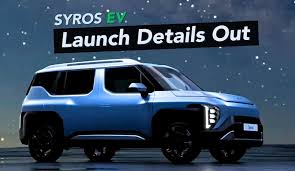
The Syros EV has been spied doing the rounds and will look very much like the ICE Syros, save for the grille and probably the wheels. Based on spy shots, the overall design remains similar to the ICE version. However, it will get EV-specific updates like a closed grille and possibly new alloy wheels to give it a distinct identity. CarWale
The Syros EV retains its upright stance, boxy proportions, muscular wheel arches, flush door handles and roof rails. At the rear, it continues with vertically positioned tail lamps and a rugged bumper design. CarWyapar
The charging port is expected on the front-left fender — a placement that has become increasingly common on Indian EVs for practical charging access.
The boxy, tallboy design of the Syros is actually well-suited to the EV format — more interior volume, better aerodynamics at city speeds compared to a coupe-SUV, and a practical road presence that works equally well as a family car or daily commuter.
Expected Features — What the ICE Syros Already Offers
Since the EV will share most of its interior with the ICE Syros, the existing car’s feature list gives us an excellent preview of what to expect.
Expected key features include ventilated front and rear seats, panoramic sunroof, Level 2 ADAS suite, 12.3-inch touchscreen infotainment, 12.3-inch digital driver display, wireless Android Auto and Apple CarPlay, automatic climate control, powered driver seat, sliding and reclining second row, wireless phone charger, auto-dimming IRVM, and 6 airbags as standard across all variants. smartprix
The ICE Syros already has several segment-first features including Over-the-Air (OTA) software updates for 16 controllers — a genuinely useful feature that keeps the car’s software current without dealership visits. Expect the EV to retain and expand this capability.
EV-specific features expected:
- V2L (Vehicle to Load) charging
- V2V (Vehicle to Vehicle) charging on higher trims
- Regenerative braking with adjustable levels
- EV-specific instrument cluster and infotainment screens
- Battery health monitoring via the Kia Connect app
Safety — Building on the ICE Syros’s 5-Star Foundation
The ICE-powered Syros has already secured a 5-star Bharat NCAP rating for adult and child occupant protection, which sets a strong benchmark for the electric version. smartprix
The EV’s body structure will be based on the same K1 platform — meaning the structural safety standards of the 5-star rated chassis carry over. Six airbags are expected as standard across all variants.
Level 2 ADAS — including Autonomous Emergency Braking, Lane Keep Assist, Blind Spot Detection, and Forward Collision Warning — is expected on higher variants, consistent with the ICE Syros’s top-trim feature set.
Expected Price — Competitive But Aggressive Needed
The Syros EV is expected to be priced between ₹15 lakh and ₹20 lakh ex-showroom. ZigWheels
At this price, it enters a segment where the Nexon EV is priced from ₹14.79 lakh and the XUV 3XO EV from ₹14.99 lakh. The Syros EV will need to offer a competitive battery size, feature-loaded variants, and a strong warranty and charging support package to stand out. carwale
The pricing is the most important variable. If Kia prices the base 42 kWh variant aggressively at ₹14 to ₹15 lakh, it becomes a genuine market disruptor. If it launches at ₹17 lakh or above without significantly better features or range than the Nexon EV, the value proposition weakens.
Kia’s track record in India — where the Syros ICE undercut expectations at launch at ₹8.99 lakh — suggests the brand understands the importance of aggressive pricing for volume.
Rivals — The Competition It Must Beat
Tata Nexon EV (₹12.49 lakh to ₹17.19 lakh): The market leader with proven reliability, dual 5-star NCAP rating, 208 mm ground clearance, and established charging infrastructure. The Syros EV must offer meaningfully better range or features to justify a higher price.
Mahindra XUV 3XO EV (₹13.89 lakh to ₹19.99 lakh): Strong range, premium interior feel, and Mahindra’s service network. The Syros EV’s Kia brand premium and feature set must justify competing.
MG Windsor EV (₹12.04 lakh to ₹16.10 lakh): The best range-per-rupee in the segment with the crossover-MPV body style. The Syros EV needs to compete on range at competitive pricing.
Maruti e-Vitara (₹13.49 lakh to ₹20.01 lakh): The biggest wildcard — Maruti’s service network is unmatched and the e-Vitara’s range of up to 543 km claimed is segment-leading. The Syros EV faces a tough comparison here.
Should You Wait for the Syros EV?
This is the practical question for any buyer considering an electric compact SUV right now.
Wait if:
- You are a current Syros ICE owner or fan who loves the brand and body style
- Your purchase timeline extends to August to October 2026
- You want Kia’s mature connected car technology (Kia Connect) in an EV format
- The Syros’s rear seat space and tallboy practicality specifically appeal to you
Do not wait if:
- You need a car within the next 3 months
- The Nexon EV or XUV 3XO EV already meet your requirements at available pricing
- You are not willing to accept possible launch delay risk — the Syros EV has already slipped from Q1 to August 2026
- Price uncertainty concerns you — final pricing could be higher than estimates
The golden rule applies here as always — never wait more than 3 to 4 months for an upcoming car in India. Launch timelines slip. If the Syros EV is not available by October 2026, do not continue waiting — buy the best available option at that time.
What Makes the Syros EV Genuinely Exciting
Beyond the specifications, the Syros EV represents something important for the Indian EV market — another strong, trusted brand committing serious volume to the affordable electric segment.
Kia’s network of over 650 outlets and its existing Syros buyer base from January 2025 onwards give it a reasonable foundation. For buyers who value service accessibility, Kia’s expanding network is meaningful — particularly compared to some newer EV brands that are still building their service infrastructure. carwale
The Syros’s existing reputation for quality, the 5-star safety rating, and Kia’s track record of delivering feature-rich products at competitive prices — these are the real reasons the Syros EV is worth watching closely.
Final Assessment
The Kia Syros EV is shaping up to be one of the most significant electric car launches of the second half of 2026 in India. If priced aggressively, it could genuinely challenge the Nexon EV’s segment leadership. If priced conservatively, it becomes a premium alternative for buyers who specifically value the Kia brand and Syros body style.
The platform is proven, the safety foundation is 5-star rated, the features will be comprehensive, and the range should be competitive. Watch for the official launch in August 2026 for confirmed pricing before making your decision.
Also read: Best Electric Cars Under ₹20 Lakh India 2026 and Tata Nexon EV Full Review 2026.
External source: Autocar India — Kia Syros EV